Automation built and run for you
Connect your apps.
Automate the busywork.Keep the receipts.
We connect your tools, automate the handoffs, and keep every workflow observable. One team from first map to production support.
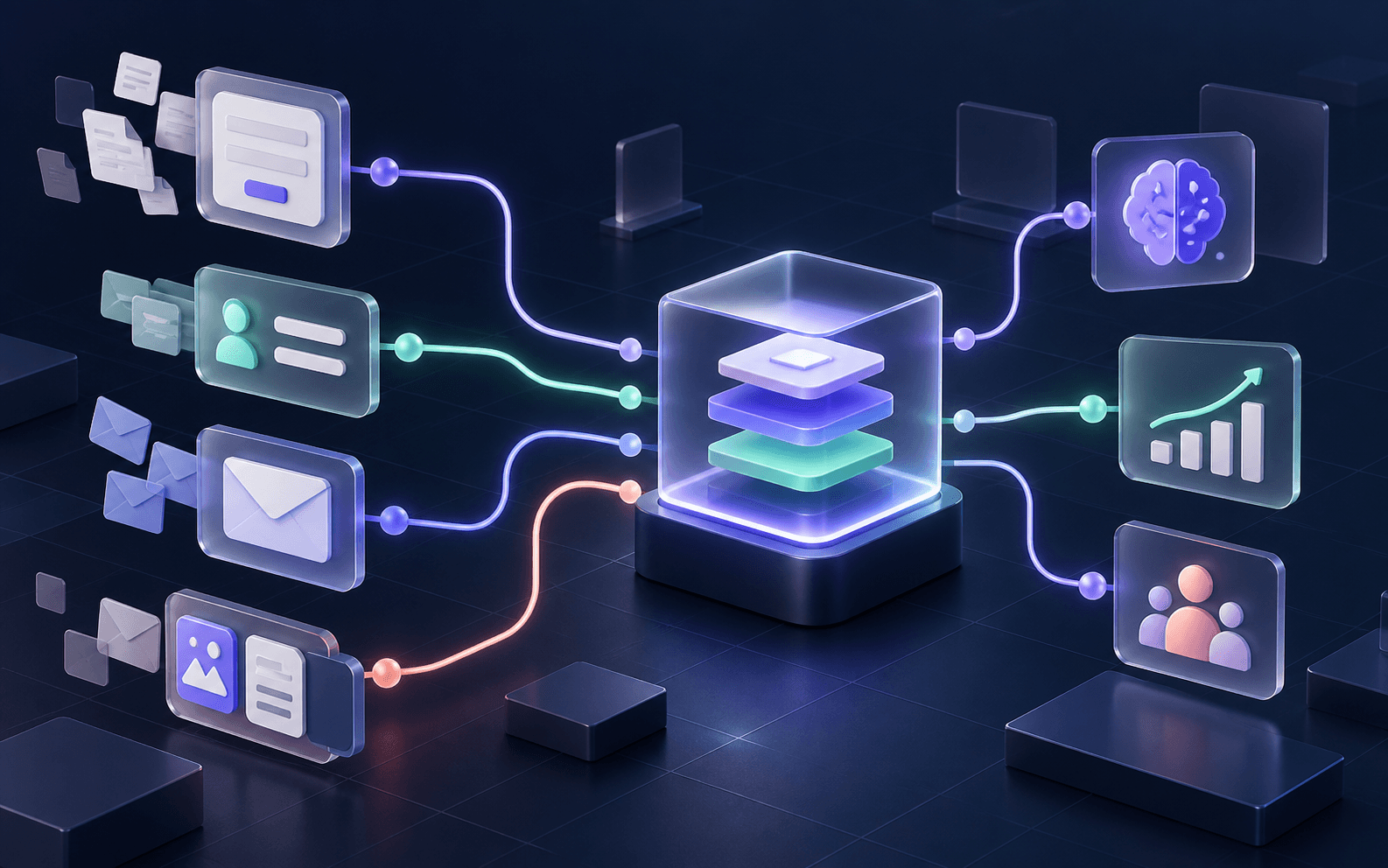
Systems we connect
If it exposes an API, a webhook, or a database we can reach, it can be part of the workflow. We confirm the specific objects and rate limits during scoping.
- CRM & sales pipelines
- Email & messaging providers
- Forms & landing pages
- Ad platforms
- E-commerce & billing
- Support desks
- Spreadsheets & databases
- Data warehouses
- Team chat
- Calendars & scheduling
- Document storage
- Model & AI providers
Capabilities
One system. Seven outcomes.
Start with the bottleneck that costs your team the most time.
App integrations
Connect APIs, webhooks, databases, and the tools your team already owns.
AI-powered workflows
Classify, summarise, and draft—with deterministic rules and human approval.
Lead capture
Capture every source with validation, consent, and attribution attached.
CRM routing
Send clean records to the right pipeline, owner, stage, and SLA.
Email nurture
Trigger relevant journeys from behaviour, segment, and consent state.
Reporting & alerting
See what ran, converted, or broke—then alert the right person.
Managed automation
Monitoring, fixes, upgrades, and a focused monthly improvement cycle.
See the system
From signal to action, in one visible flow
Inputs arrive messy. Scaling validates, decides, delivers, and records what happened.
- lead response target
- < 60 sec
- workflow monitoring
- 24 / 7
- for runs and outcomes
- 1 view
Signals in
- Website forms
- Ad platforms
- Store & checkout
- Shared inbox
Scaling engine
- Validate & de-duplicate
- AI enrich & score
- Branch on rules
- Log & report
Delivered to
- CRM record
- Nurture email
- Team alert
Every run logged & retried
Use cases
Pick a funnel. See the flow.
B2B and B2C share the engine—not the rules.
Longer cycles, named accounts, and a sales team that needs context — not another unqualified inbox.
Inbound demo request to a booked meeting
- Capture the form server-side with consent and campaign attribution
- Enrich the company, then score fit against your written ICP rules
- Route hot leads to an owner with a summary; queue the rest for nurture
Every request gets a decision the same day, with the reasoning attached.
Quote and proposal follow-through
- Trigger on the CRM stage change that means “proposal sent”
- Schedule follow-up touches that cancel themselves when the prospect replies
- Escalate to the account owner at the thresholds you define
Follow-up stops depending on who remembers.
Partner and reseller lead exchange
- Normalise each partner feed into one internal record format
- De-duplicate against existing accounts before anything is created
- Attribute the lead to the partner for downstream revenue share reporting
One clean pipeline instead of three reconciliation jobs.
How it works
A four-step engagement, not an open-ended project
Most first workflows go live inside a month.
- 1Week 1
Map the workflow as it really runs
We capture the real steps, exceptions, and success metric.
You getWorkflow map + build list
- 2Weeks 2–3
Build on accounts you own
We build in your workspace with accounts your company owns.
You getTested staging workflow
- 3Week 4
Validate against real traffic
Real data, failure paths, and human checkpoints prove the workflow.
You getTest log + go-live sign-off
- 4Ongoing
Run, watch, and improve
We monitor runs, fix breakage, and improve the next bottleneck.
You getMonthly run report
Engagements
Fixed scope, quoted before anything starts
Indicative starting points in USD. The scoping call ends with a written scope and a fixed number — not an hourly estimate that drifts.
Workflow sprint
From $3,500one-time, per workflow
One clearly defined workflow, mapped, built, tested, and handed over with a runbook. The usual starting point.
- Discovery session and workflow map
- One production workflow with up to 6 integrations
- Test plan, failure handling, and alerting
- Runbook plus a handover walkthrough
- 30 days of post-launch fixes
Automation retainer
Most chosenFrom $4,500per month
A standing build-and-run capacity: a rolling backlog of workflows plus monitoring and support for everything already live.
- Everything in the workflow sprint
- Rolling build backlog you reprioritise monthly
- Monitoring, alerting, and on-call fixes
- Monthly run report and improvement review
- Named contact with agreed response times
Managed operations
Customquoted per scope
You hand over an existing automation estate — ours or inherited — and we own its reliability, documentation, and roadmap.
- Audit of existing workflows and integrations
- Migration and consolidation plan
- Documented ownership for every workflow
- Quarterly roadmap and cost review
- Security and access review
FAQ
The questions that come up on every first call
Something not covered here? Send the question straight to admin@scaling.vn and you will get a real answer, not a sequence.
Which platform do you build on?
Usually a self-hosted or cloud workflow platform in your own account, with code-level steps where a visual node would be fragile. If you already run something in-house, we build on that rather than adding another tool to your stack.
Do we need engineers on our side?
No. We need someone who understands the process and someone who can approve access to the systems involved. If you do have engineers, we will work to their conventions and hand over code they can read.
What happens to our automations if we stop the retainer?
They keep running. Everything lives in accounts you own and control, and each workflow ships with a runbook covering what it does, what it touches, and how to pause it. We also offer a paid handover session for whoever picks it up.
How do you handle our data?
Data stays in your systems. We work with least-privilege credentials stored in your secret manager, we do not copy production data into our own tools, and access is revoked at the end of an engagement. Data processing terms are signed before any build starts.
Where does AI actually get used?
Where deterministic rules run out: classifying free-text enquiries, summarising long threads, extracting fields from messy inputs, and drafting replies. Anything customer-facing ships behind a human approval step by default, and every prompt is versioned alongside the workflow.
Can you work with our existing CRM and email provider?
Yes. Anything with a documented API, webhook support, or a database we can reach is in scope. During scoping we confirm the specific objects, fields, and rate limits involved before committing to a build.
How quickly can something go live?
A single well-defined workflow typically goes live within about four weeks, including a validation period against real traffic. Larger consolidations run longer and are broken into sequenced releases so value arrives before the whole programme finishes.
What if a workflow breaks at 2am?
Failures raise an alert to the channel you nominate, and failed records are retried or parked rather than silently dropped. Support windows and escalation paths are written into the engagement so you know exactly what response to expect.
Start here
Tell us the workflow that keeps breaking
Eight fields. No demo gate, no discovery questionnaire, no automated sequence afterwards — a person reads every brief that comes through this form.
- 1A 45-minute scoping callWe walk your current process end to end and separate what is worth automating from what is worth deleting.
- 2A workflow map you keepYou leave the call with a written map of the workflow and its exceptions, whether or not you hire us.
- 3A fixed quote, not a rangeIf there is a fit, you get a written scope and a fixed number within two business days.
Prefer email? Write to admin@scaling.vn with a couple of lines about the process and we will reply with the same questions this form asks.